Skip to content

Evidence-based fitness. Personalized by science.

Your training plan should be built on science.

Not another workout app. A science-based system for training, nutrition, and progression.

Explore the Science

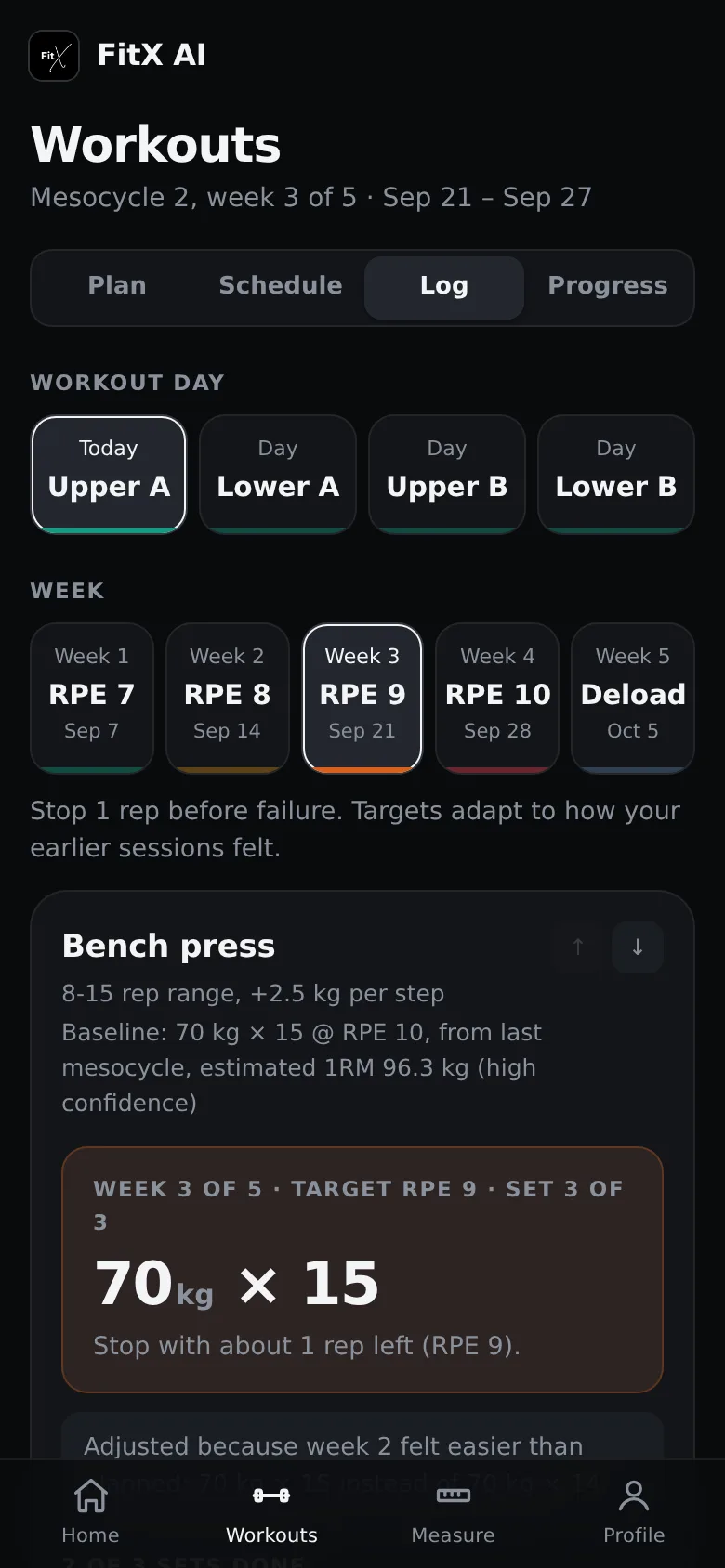
FitX AI Log screen: this week's training phase, the effort target and the target weight and reps for the next set.
Training phaseMesocycle 2 · Week 3 of 578910D
Effort targetRPE 9Stop with about 1 rep left
Bench press · next set70 kg × 152 of 3 sets done
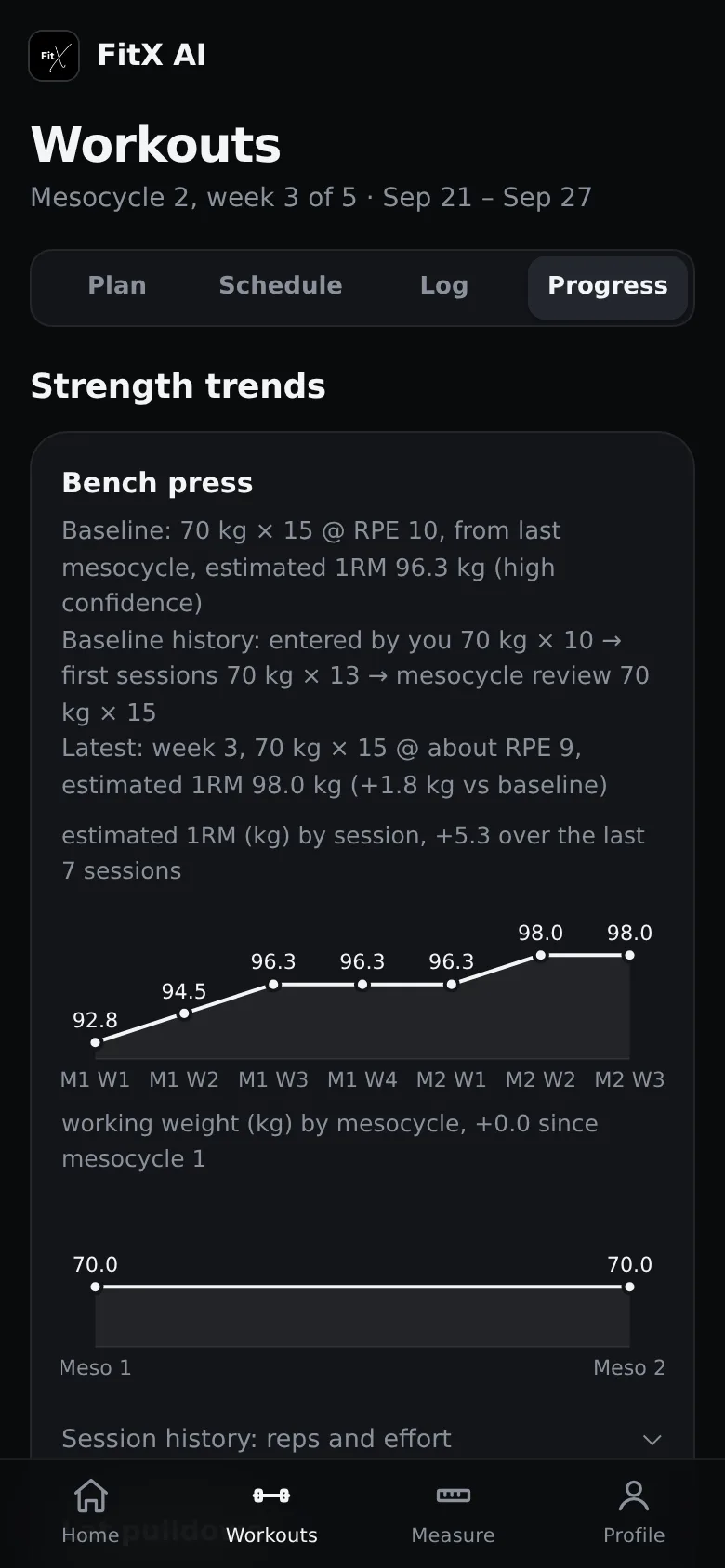
Estimated 1RM · Bench press98.0 kg+5.2 kg over 7 sessions

Built from evidence. Designed for real-world training.

Fitness advice is everywhere.
A system you can actually understand is not.

FitX AI turns established exercise-science principles into practical decisions about training, effort, progression, and nutrition.

The difference

Most fitness apps give you workouts. FitX AI gives you a system.

FitX AI
  • Training

    A plan from weekly sets per muscle, fitted to your days, time, equipment and injuries.

  • RPE

    Effort targets, not the same weight every week. You report reps left; targets follow.

  • 1RM

    An estimated one-rep max from every rated set, used to set targets.

  • Periodization

    5-week blocks: rising effort, a deload, then a review.

  • Nutrition Calories live

    A daily calorie target from your BMR, activity, training and goal.

  • Progress

    Strength trends, block history and weekly measurements.

Built on science

Built on research. Not gym myths.

FitX AI is built around principles studied across decades of exercise and sports science. Each one runs from the evidence to a rule you can see in the app.

01

Progressive overload

  1. Research
  2. Principle

    Adaptation needs a gradually growing challenge.

  3. FitX AI rule

    Reach the top of your rep range at the planned effort and the weight goes up at least 2% (5% for leg and hip lifts).

  4. What you get

    A heavier target, back inside your range.

Read the evidence

What the research says

Progress needs a growing challenge. The ACSM recommends a 2-10% load increase once you exceed your target reps, and adding reps works as well as adding weight.

How FitX AI applies it

Your reps rise inside the 8-15 range first. Reach the top at the planned effort and the weight goes up by at least 2% (5% for leg and hip lifts).
02

Weekly volume

  1. Research
  2. Principle

    More weekly sets tend to help, with diminishing returns.

  3. FitX AI rule

    Weekly sets per muscle by experience: 8-12, 12-16 or 16-20. Helping muscles count half a set.

  4. What you get

    A set count for every muscle, every week.

Read the evidence

What the research says

More weekly sets per muscle tend to give more growth, with diminishing returns. In trained lifters, going beyond about 20 sets has not reliably added more.

How FitX AI applies it

Weekly sets per muscle by experience: 8-12, 12-16 or 16-20 for major muscles. Helping muscles count half a set.

03

Reps & load

  1. Research
  2. Principle

    Muscle grows across a broad range of reps when sets are hard.

  3. FitX AI rule

    A default working range of 8-15 reps.

  4. What you get

    A weight that lands your reps inside 8-15.

Read the evidence

What the research says

Muscle grows across a wide range of loads when sets are hard. Heavier loads build more maximal strength, and very light loads are less effective.

How FitX AI applies it

A default 8-15 working range: moderate loads that support both growth and strength.

04

Effort & proximity to failure

  1. Research
  2. Principle

    Train close to failure. Complete failure isn't required.

  3. FitX AI rule

    Effort rises across the block: RPE 7, 8, 9, then 10 on the last set of week 4.

  4. What you get

    This week's effort target on every set.

Read the evidence

What the research says

Training to complete failure is not clearly better than stopping a little short. Growth improves as sets end closer to failure; strength is less sensitive.

How FitX AI applies it

Effort rises across the block, from RPE 7 (3 reps left) to RPE 10 on the last set of week 4.

05

Periodization & deload

  1. Research
  2. Principle

    Phased training helps strength. Fatigue needs planned relief.

  3. FitX AI rule

    5-week blocks: four building weeks, a deload, then a review.

  4. What you get

    A deload in week 5: same weights, half the sets.

Read the evidence

What the research says

With volume matched, periodized training improves 1RM strength more than non-periodized training. A deload is a planned period of reduced stress to manage fatigue.

How FitX AI applies it

5-week blocks: four weeks of rising effort, a deload in week 5, then a review that sets the next block.

06

Energy needs

  1. Research
  2. Principle

    Energy needs can be estimated, and they shift as weight changes.

  3. FitX AI rule

    Mifflin-St Jeor BMR × activity, plus training and your goal, recalculated from your latest weigh-in.

  4. What you get

    A daily calorie target that moves with you.

Read the evidence

What the research says

Resting energy needs can be estimated from weight, height, age and sex. Weight responds slowly to a calorie change, and needs shift as weight changes.

How FitX AI applies it

A daily calorie target from the Mifflin-St Jeor BMR, activity, training and goal, recalculated from your latest weigh-in.

Six more principles behind the system
07

Training frequency

  1. Research
  2. Principle

    With weekly sets matched, once or twice a week both work.

  3. FitX AI rule

    Each muscle twice a week by default, or once if you prefer. Weekly sets stay the same.

  4. What you get

    Each muscle on one or two days of your split.

Read the evidence

What the research says

With weekly sets matched, training a muscle once or more often gives similar growth. Frequency matters more for strength.

How FitX AI applies it

Twice a week per muscle by default, or once if you prefer. The weekly sets stay the same either way.

08

Reps in reserve

  1. Research
  2. Principle

    Reps-left ratings are a practical, if imperfect, effort gauge.

  3. FitX AI rule

    You tap reps left after each set. Week 1 calibrates.

  4. What you get

    Next targets that follow what you actually did.

Read the evidence

What the research says

Rating a set by the reps you had left is a practical effort scale. People tend to underestimate by about a rep, and get more accurate closer to failure.

How FitX AI applies it

You tap reps left after each set. Week 1 is calibration, and the next targets follow what you actually did.

09

Exercise selection

  1. Research
  2. Principle

    Vary exercises with purpose, not at random.

  3. FitX AI rule

    The same exercises through a block. A muscle's second weekly session uses a different one where possible.

  4. What you get

    Stable lifts you can actually progress.

Read the evidence

What the research says

Planned variety can help; constant random rotation may hold gains back. Compound lifts train helping muscles less than direct work does.

How FitX AI applies it

Exercises stay the same through a block. A muscle's second weekly session uses a different exercise where possible.

10

Rest between sets

  1. Research
  2. Principle

    Rest long enough to perform on the next set.

  3. FitX AI rule

    Session time allows about 2 minutes per big-lift set and 90 seconds per small one.

  4. What you get

    A plan that fits your session length.

Read the evidence

What the research says

Resting more than 60 seconds may slightly help growth; past about 90 seconds, little difference was seen.

How FitX AI applies it

Session lengths allow about 2 minutes per set for big lifts and 90 seconds for small ones.

11

Estimating 1RM

  1. Research
  2. Principle

    A 1RM can be estimated from multi-rep sets, with uncertainty.

  3. FitX AI rule

    An estimated 1RM from every rated set. Heavy sets use the middle of four formulas.

  4. What you get

    A strength trend you can watch, not a tested max.

Read the evidence

What the research says

A 1RM can be estimated from multi-rep sets, most precisely from fewer reps. Reps at a given %1RM vary between people.

How FitX AI applies it

An estimated 1RM from every rated set, used as a trend and a guide, never as a tested max. Heavy sets use the middle of four formulas.

12

Protein

Coming soon in the app
  1. Research
  2. Principle

    Adequate daily protein supports training results.

  3. FitX AI rule

    Coming soon: protein per kilogram of body weight.

  4. What you get

    Coming soon.

Read the evidence

What the research says

Adequate daily protein supports training results. Most exercising people do well around 1.4-2.0 g per kg of body weight.

How FitX AI applies it

Coming soon: protein targets per kilogram of body weight, with food logging.

The research library

Every principle is traceable to the paper it came from.

Verified research papers
29
Evidence areas
12
Meta-analyses & systematic reviews
15
Traceable to DOI and PubMed
100%

Meta-analysis2017

Training volume · Hypertrophy

Dose-response relationship between weekly resistance training volume and increases in muscle mass: A systematic review and meta-analysis

Schoenfeld BJ, Ogborn D, Krieger JW · Journal of Sports Sciences

FindingAcross 15 studies, more weekly sets per muscle went with more muscle growth, in a graded dose-response.

How FitX AI uses itFitX AI plans and counts training as weekly sets per muscle, and shows you where each muscle stands against its target.

Meta-analysis2025

Training volume · Training frequency

The Resistance Training Dose Response: Meta-Regressions Exploring the Effects of Weekly Volume and Frequency on Muscle Hypertrophy and Strength Gains

Pelland JC, Remmert JF, Robinson ZP et al. · Sports Medicine

FindingIn 67 studies, muscle size and strength rose with weekly sets but with diminishing returns; frequency mattered for strength more than for size.

How FitX AI uses itFitX AI counts a set as one set for the main muscle and half a set for helping muscles, sets weekly targets by experience instead of 'more is always better', and lets you train each muscle once or twice a week.

Meta-analysis2019

Training frequency · Hypertrophy

How many times per week should a muscle be trained to maximize muscle hypertrophy? A systematic review and meta-analysis of studies examining the effects of resistance training frequency

Schoenfeld BJ, Grgic J, Krieger J · Journal of Sports Sciences

FindingWith weekly sets matched, training frequency made no meaningful difference to muscle growth in 25 studies.

How FitX AI uses itFitX AI lets you choose once or twice a week per muscle, and keeps the weekly sets the same either way.

Meta-analysis2023

RPE & autoregulation · Hypertrophy

Influence of Resistance Training Proximity-to-Failure on Skeletal Muscle Hypertrophy: A Systematic Review with Meta-analysis

Refalo MC, Helms ER, Trexler ET et al. · Sports Medicine

FindingTraining to complete failure was not shown to beat stopping a little short of it for muscle growth.

How FitX AI uses itFitX AI only asks for a true all-out effort (RPE 10) on the last set of the hardest week. Most sets finish with 1-3 reps left.

Measurement study2016

RPE & autoregulation

Novel Resistance Training-Specific Rating of Perceived Exertion Scale Measuring Repetitions in Reserve

Zourdos MC, Klemp A, Dolan C et al. · Journal of Strength and Conditioning Research

FindingIntroduced the reps-in-reserve RPE scale (RPE 10 = 0 reps left, RPE 9 = 1 left) and found it tracked bar speed.

How FitX AI uses itFitX AI uses the same scale: RPE 10 means no reps left, RPE 9 one left, RPE 8 two, RPE 7 three.

Measurement study1990

Energy balance

A new predictive equation for resting energy expenditure in healthy individuals

Mifflin MD, St Jeor ST, Hill LA et al. · The American Journal of Clinical Nutrition

FindingThe Mifflin-St Jeor equation: resting energy expenditure from weight, height, age and sex.

How FitX AI uses itFitX AI uses this exact equation for your BMR, the starting point of your daily calorie target.

Explore all 29 papers

Summaries are written from each paper's published abstract. Every citation is checked automatically against Crossref and PubMed. Open the research library

How the science becomes your plan

From research to your next session.

Built once, from the evidence

  1. 01

    Research

    Peer-reviewed exercise and nutrition literature.

  2. 02

    Principles

    Practical rules with sensible ranges, not single magic numbers.

  3. 03

    Training rules

    A 5-week block: sets, effort, reps and load.

  4. 04

    Personalization

    Your goal, experience, days, time, equipment and injuries.

  5. 05

    Your plan

    Weekly sets per muscle, on your days.

Then, every session

  1. Your performance

    Weight, reps and reps left, logged set by set.

  2. Next target

    Worked out from what you actually did.

  3. Next session

    Same rules, new numbers.

Not a chatbot

Not a chatbot guessing your workout.

FitX AI uses explicit training rules and measurable inputs: deterministic, inspectable rules, not a chatbot generating workouts. The same inputs give the same plan, and when a target changes, the app tells you why.

  1. Last session · week 240 kg × 152 reps left (RPE 8). Planned: 40 kg × 12 at RPE 8.
  2. What happened?

    You reached the top of the 8-15 rep range at the planned effort.

  3. Decision

    Increase the load.

    At least 2%, rounded up to the next 2.5 kg step.
  4. Next session · week 342.5 kg × 12Target RPE 9. +6% load, back inside the range.
  5. Why?

    Progressive overload within the programmed effort and rep range.

Worked out by FitX AI's own progression engine when this page was built, for a bench press starting from 40 kg × 14. Same inputs, same answer, every time.

The product

The actual system. Real screens, real training data.

Log

Every set has a reason.

This week's effort, the weight and reps for each set, and what changed since last time. Tap the reps you had left and the next targets follow.

  1. Your rep range
  2. This week's effort target
  3. Target weight and reps
  4. How hard to push this set
  5. Why the target changed
A Log card: the rep range, this week's target RPE, the target weight and reps, why the target changed, and the reps-left buttons.
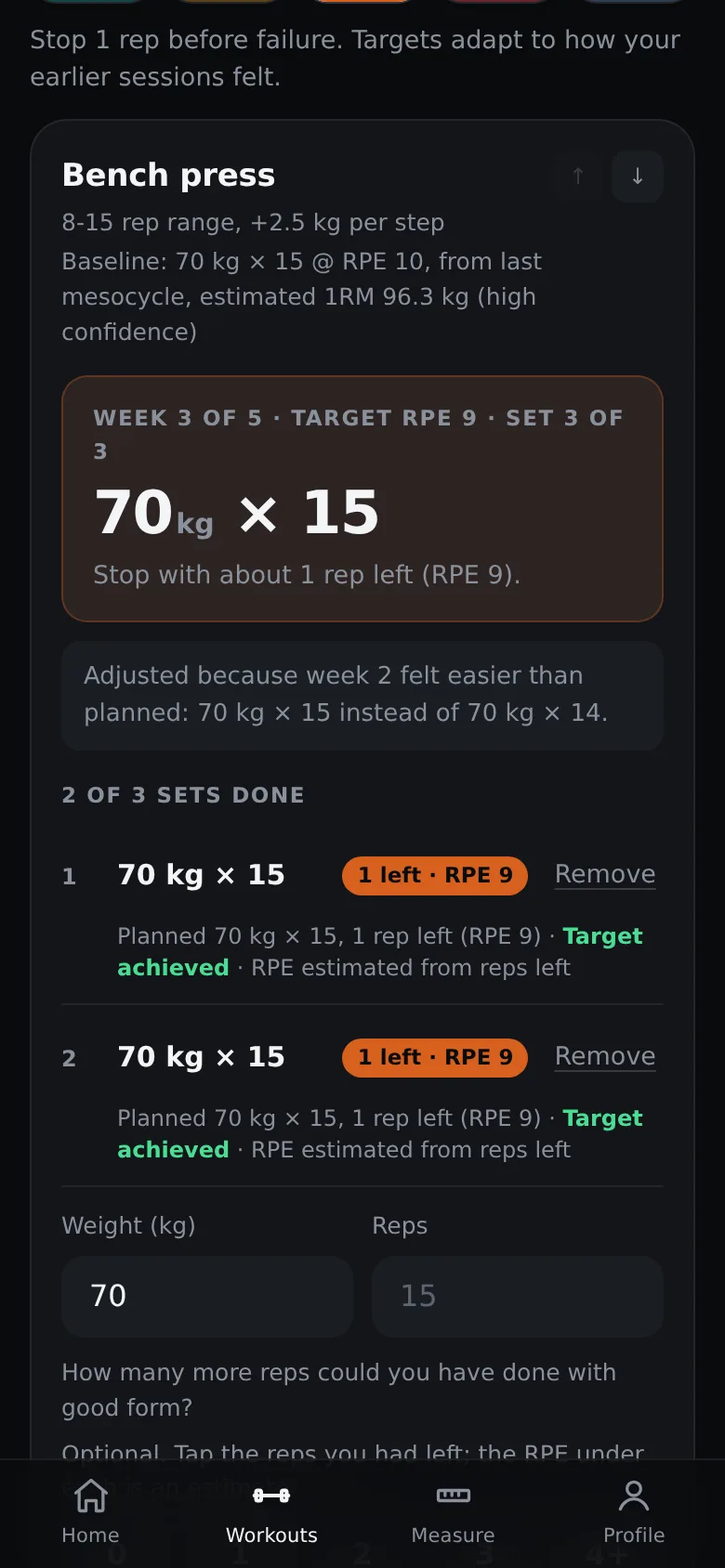
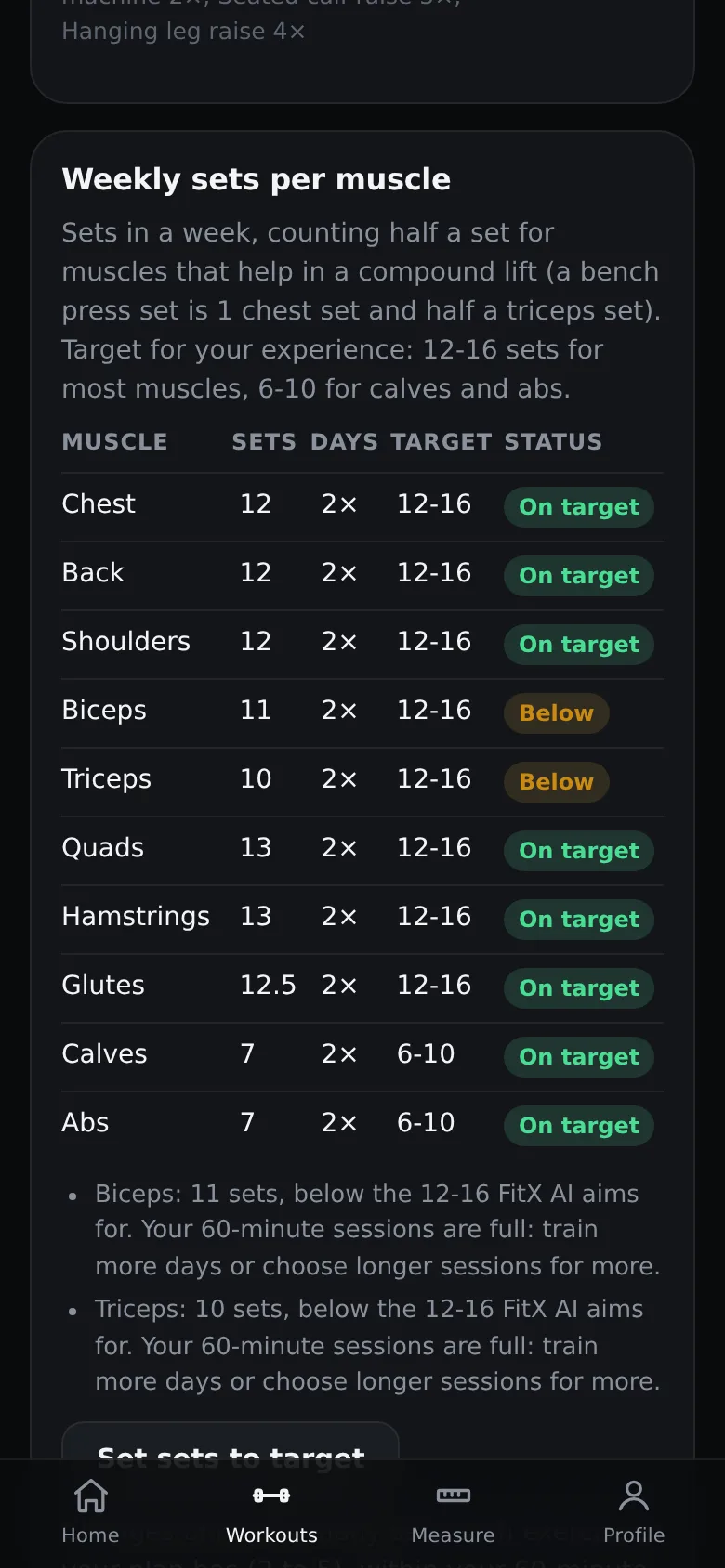
12345

Plan

Weekly sets per muscle, not random splits.

Each muscle gets a weekly number of sets for your experience, trained once or twice a week and fitted to your session length. Helping muscles count half a set. 227 exercises to choose from.

Plan screen: weekly sets per muscle against their targets.

Progress

See whether you're actually getting stronger.

Estimated 1RM by session for every lift, and block-by-block history.

  1. Estimated 1RM, session by session
Progress screen: estimated one-rep max by session for bench press.
1

Schedule

Know where you are in the block.

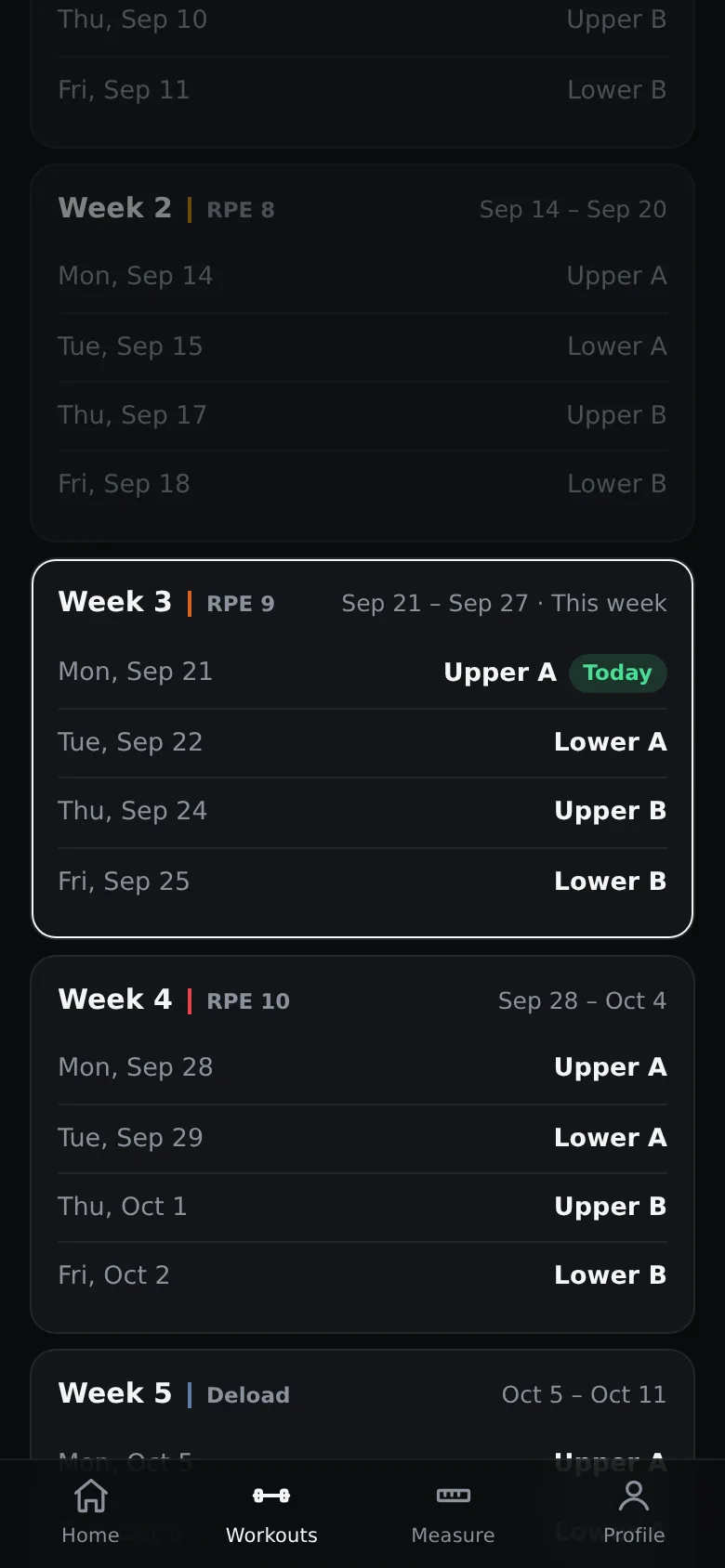
Every week of the block on real dates, with its effort target, through to the deload.

  1. This week, in the block
Schedule screen: the weeks of the current block with their RPE targets and this week highlighted.
1

Calories

Understand your calorie target.

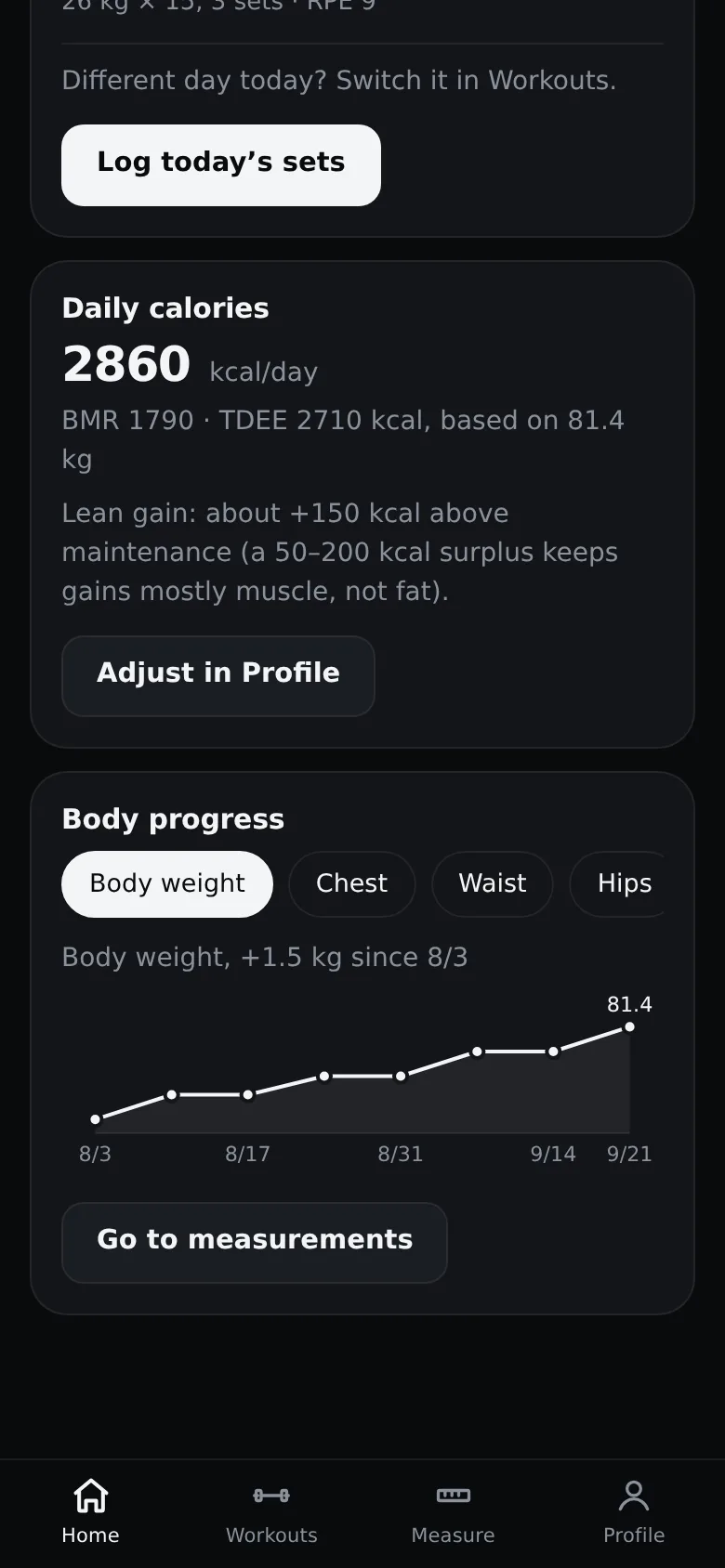
A daily target with its working shown: BMR and TDEE, based on your latest weigh-in.

  1. Your daily calorie target
  2. The BMR, TDEE and weight behind it
Home screen: the daily calorie target with BMR, TDEE and the body weight it is based on.
12

Measure

Your body, week by week.

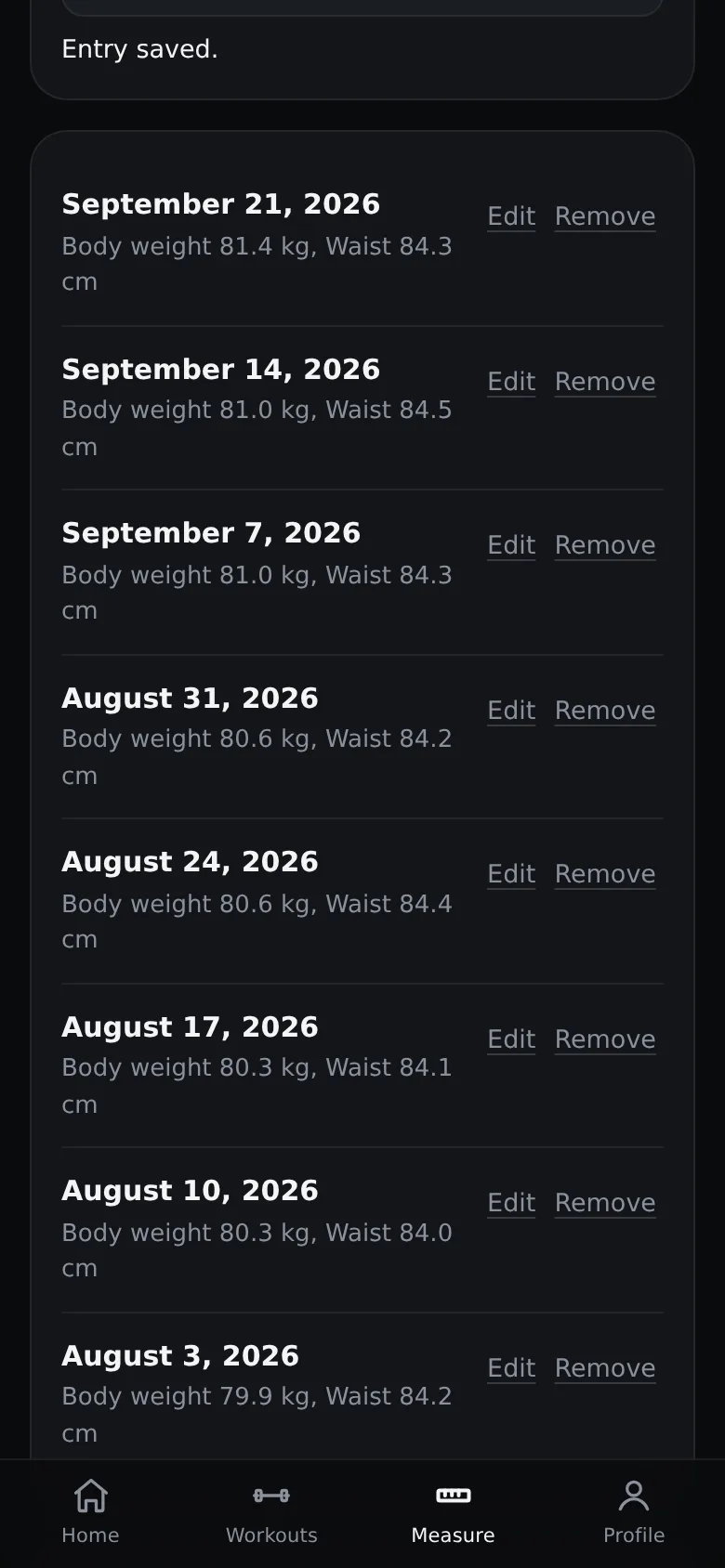
Body weight and measurements over time. Your weigh-ins feed straight back into your calorie target.

Measurements screen: weekly body weight and waist entries.

Screens captured from the app with demo training data logged through its own engine.

Training system

Training that progresses with you.

Each block starts conservative and builds. Effort rises week by week, a deload clears fatigue, and your results set the next block.

  1. Week 1RPE 7

    Calibrate

    3 reps left. A deliberately easier start; your logged sets fine-tune the targets.

  2. Week 2RPE 8

    Train

    2 reps left. Beat the top of your range and the weight goes up.

  3. Week 3RPE 9

    Progress

    1 rep left. Hard sets close to failure.

  4. Week 4RPE 10

    Peak

    One all-out last set per exercise; the rest stay at RPE 9.

  5. Week 5Deload

    Deload

    RPE 5-6. Same weights, half the sets, lower effort.

  6. ThenNext block

    Reassess

    Your sessions set the next block's start, with increases capped at 10%.

The terms, explained
RPE
Rate of Perceived Exertion: how hard a set was. RPE 10 means nothing left; RPE 8, two reps left.
RIR
Reps in reserve: the reps you could still have done. You tap it after every set.
1RM estimation
Your one-rep max, estimated from the weight and reps-to-failure of a set. A guide for targets, never a tested max.
Rep range
8-15 reps by default: a practical working range, since muscle grows across a broad range of reps when sets are hard.
Load progression
Reach the top of your range at the planned effort and the weight rises by at least 2% (5% for leg and hip lifts).
Mesocycle
A training block of 5 weeks: four building weeks and a deload.
Deload
A planned lighter week to manage fatigue before the next block.
Performance tracking
Every rated set updates your estimated 1RM, so you can see if you are actually getting stronger.

Nutrition

Your training doesn't exist in isolation.

Your calorie target is built from your body, your activity, your training and your goal. It is an estimate: it is recalculated as your weight changes, and your real progress is the final check.

Coming soonProtein, carbohydrates, fat and a food log. Today, FitX AI gives you a calorie target only.

Worked example

The demo lifter in the screens above: male, 31, 180 cm, 81.4 kg, moderate activity, 4 × 60-minute sessions, lean gain.

  1. BMRMifflin-St Jeor: 10 × 81.4 + 6.25 × 180 − 5 × 31 + 51,789
  2. ActivityModerate day-to-day activity× 1.4
  3. Training4 sessions × 60 min, at 6 kcal a minute, spread over the week+ 206
  4. TDEEMaintenance estimate2,710
  5. GoalLean gain+ 150
  6. Daily targetRounded to 10, as the app shows it2,860 kcal
  1. Real-world progressWeekly weigh-ins in Measure.
  2. AdjustmentThe target is recalculated from your latest weight.

Why FitX AI

A different philosophy.

Traditional workout apps

  • Exercise database
  • Static routines
  • Generic workouts
  • Fixed weights
  • Workout tracking
  • Separate nutrition
  • Little explanation

FitX AI

  • Training systemPlans built from weekly sets per muscle.
  • Structured progression5-week blocks with rising effort and a deload.
  • Individualized programmingYour experience, days, time, equipment and injuries.
  • RPE-informed loadingTargets follow the reps you had left.
  • Performance feedbackEstimated 1RM from every rated set.
  • Integrated nutritionCalorie target linked to your training and weight.
  • Research transparencyPrinciples and sources you can check.

Transparency

We show you the reasoning.

You shouldn't have to blindly trust an algorithm. When FitX AI changes a target, it says why, and every principle traces back to the research.

Target changed · Hip abduction machine

51 kg × 1553 kg × 13

“Adjusted because you reached the top of your rep range in week 1 (+6%): 53 kg × 13 instead of 51 kg × 15.”The app's own note

  1. Because you reached the top of your rep range in week 1 (+6%).

  2. Progressive overload. Progress needs a growing challenge. The ACSM recommends a 2-10% load increase once you exceed your target reps, and adding reps works as well as adding weight.

Real notes FitX AI showed the demo account in the screens above.

Our research standard

Science doesn't mean pretending there is one perfect answer.

Exercise research contains uncertainty, different methodologies and evolving evidence. FitX AI uses established evidence to build a practical training system, and makes the principles and sources behind it transparent.

01

Principles, not promises

Research supports the principles FitX AI uses. The app itself has not been tested in a clinical trial, and results vary between people.

02

Checked sources

Every citation is verified against Crossref and PubMed and links to the original paper.

03

Limits stated

Each paper page lists its limitations next to its findings.

Philosophy

Fitness should be understandable.

FitX AI isn't designed to make fitness complicated. It turns exercise science into practical decisions, so you can focus on training.

  • What should I train?A plan from weekly sets per muscle, fitted to your days, time and equipment.
  • How hard should I train?An effort target for every week, from RPE 7 up to 10.
  • How much should I lift?A target weight and reps for each set, from your estimated 1RM.
  • When should I progress?When you reach the top of your rep range at the planned effort.
  • When should I deload?Every fifth week, planned in advance.
  • How much should I eat?A daily calorie target for your goal, updated as your weight changes.
  • Am I actually progressing?Estimated 1RM trends, block history and weekly measurements.

Stop guessing.
Start training with a system.

Evidence-based principles. Personalized training. Transparent progression.

Explore the Research

Loading...